
The Definitive Guide to Gutter Sizes and Dimensions

Choosing the right gutter size is essential for protecting your home from water damage. Gutters that are too small may overflow during heavy rainfall, while an improperly sized drainage system may allow water to collect around your foundation, damage landscaping, or affect your home’s exterior.
The most common residential gutter sizes are 5-inch and 6-inch gutters. However, the right size for your property depends on several factors, including roof drainage area, roof pitch, rainfall intensity, gutter style, and downspout capacity. Whether you are installing new gutters or replacing an existing system, understanding standard gutter sizes, dimensions, and lengths can help you make an informed decision.
In this guide, we explain how to calculate the right gutter size, compare common gutter dimensions, and identify the factors that affect your home’s drainage requirements.
What Are the Standard Gutter Sizes?
Most residential properties use 5-inch or 6-inch gutters. These measurements refer to the nominal width of the gutter opening, although actual dimensions vary depending on the gutter profile and manufacturer.
Larger gutters, including 7-inch and 8-inch systems, are also available for properties with greater drainage requirements.
Here is an overview of common gutter sizes and their typical applications.

| Gutter size | Common application |
| 4-inch gutters | Smaller or specialized drainage applications |
| 5-inch gutters | Most standard residential applications |
| 6-inch gutters | Larger residential roofs and higher drainage requirements |
| 7-inch gutters | Large residential and commercial applications |
| 8-inch gutters | Commercial and specialized drainage systems |
5-Inch Gutters
Five-inch gutters are among the most common residential gutter sizes. They provide sufficient drainage capacity for many standard homes when properly installed with appropriately sized downspouts. They are commonly available in K-style and half-round profiles.
6-Inch Gutters
Six-inch gutters have a wider opening and greater water-handling capacity than 5-inch gutters of the same profile. They are often considered for properties with larger roof areas, steeper roof pitches, or higher rainfall requirements.
7-Inch and 8-Inch Gutters
Larger gutters are generally used when standard residential gutter sizes cannot accommodate the expected runoff. These systems may require custom ordering and professional installation. Keep in mind that selecting a larger gutter does not automatically solve drainage problems. Downspout capacity, gutter pitch, roof drainage area, and installation configuration must also be considered.
Understanding Gutter Dimensions
Gutter dimensions are generally described by three measurements: width, depth, and length. Understanding these measurements helps when selecting replacement gutters or determining the requirements of a new installation.
Gutter Width
Gutter width refers to the nominal measurement across the top opening of the gutter. For example, a 5-inch K-style gutter has a nominal opening of 5 inches, while a 6-inch K-style gutter has a wider opening. The opening affects how much rainwater the gutter can collect before directing it toward the downspouts.
Gutter Depth
Gutter depth refers to the vertical distance between the top edge and bottom of the gutter. The depth and shape of the gutter affect its overall water capacity. Two gutters with the same nominal width may have different capacities because of differences in their profiles.
Gutter Length
Gutter length refers to the linear measurement of the gutter along the roofline. Sectional gutters are manufactured in predetermined lengths and connected during installation. Seamless gutters, on the other hand, are fabricated on-site to match the measurements of the property.
The total gutter length required depends on the roofline and the number of sections that need drainage.
K-Style vs. Half-Round Gutter Sizes
K-style and half-round gutters are two of the most common gutter styles used on residential properties. Although both styles are available in different sizes, their profiles affect their dimensions and water-handling capacity.
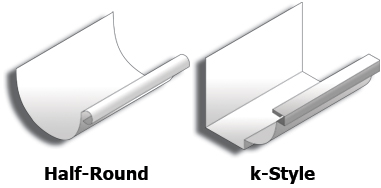
K-Style Gutters
K-style gutters are recognizable by their decorative front profile, which resembles crown molding. They are popular for residential properties because of their appearance and drainage capacity.
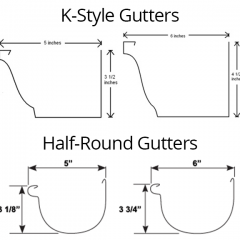
The most common K-style gutter sizes are 5 inches and 6 inches.
5-Inch K-Style Gutter Dimensions
Five-inch K-style gutters are widely used on residential homes. They provide a practical balance between drainage capacity, appearance, and installation requirements.
According to the gutter-sizing capacity figures discussed later in this guide, a 5-inch K-style gutter can accommodate a drainage area of up to 5,520 square feet under the stated sizing assumptions.
6-Inch K-Style Gutter Dimensions
Six-inch K-style gutters have a larger opening and greater drainage capacity than their 5-inch counterparts. They are often considered for larger homes, steep roofs, and properties that experience heavier rainfall. The published sizing figures in this guide list a drainage capacity of up to 7,960 square feet for a 6-inch K-style gutter, subject to the assumptions used in the sizing calculation.
Half-Round Gutters
Half-round gutters have a curved, semicircular profile. They are frequently selected for traditional homes and properties where architectural appearance is an important consideration. Common residential sizes include 5-inch and 6-inch half-round gutters.
Their rounded profile differs from K-style gutters, which affects their water capacity. A 6-inch half-round gutter should not automatically be considered equivalent to a 6-inch K-style gutter. Their shapes and drainage characteristics are different.
When comparing gutter styles and sizes, consider both the nominal dimensions and the expected water flow.
How to Determine the Right Gutter Size for Your Home
Choosing the right gutter size requires evaluating the amount of rainwater that will flow from your roof into the drainage system.
The original sizing methodology used in this guide considers three important factors:
- Roof drainage area.
- Roof-pitch factor.
- Maximum rainfall intensity.
These factors help determine the effective drainage area that the gutter system must accommodate.
1. Calculate Your Roof’s Drainage Area
The first step is to calculate the square footage of the roof area that drains into each gutter section. For a simple gable-end roof, you will need to calculate the area of each roof slope separately. Multiply the length by the width of each surface to determine its drainage area.
For example:
- Roof length: 40 feet
- Horizontal roof width: 25 feet
- Drainage area: 40 x 25 = 1,000 square feet
For hip roofs and intersecting roofs, the process requires additional calculations. Measure each individual roof surface that contributes water to a particular gutter and add the areas together.
The goal is to determine the total roof area draining into each gutter section rather than simply calculating the entire roof’s footprint.
2. Adjust for Roof Pitch
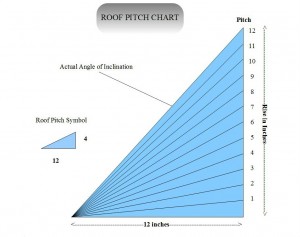 Roof pitch refers to how steeply a roof slopes. Steeper roofs can collect more wind-driven rain and direct water into the gutters more quickly. This is why roof pitch must be considered when determining the appropriate gutter size.
You can measure roof pitch using a 2-foot level and a tape measure. Hold one end of the level against the roof, making sure the level is horizontal. Measure the distance between the roof and the underside of the level at its midpoint, which represents a 12-inch run.
For example, a 5-inch measurement indicates a 5-in-12 roof pitch. Once you determine the roof pitch, use the following adjustment factors.
| Roof pitch | Roof-pitch factor |
| Flat to 3 in 12 |
1 |
| 4 in 12 to 5 in 12 |
1.05 |
| 6 in 12 to 8 in 12 |
1.1 |
| 9 in 12 to 11 in 12 |
1.2 |
| 12 in 12 or higher |
1.3 |
The steeper the roof, the higher the adjustment factor used in the original sizing methodology.
3. Consider Maximum Rainfall Intensity
Rainfall intensity is another important factor when determining the appropriate gutter size.
A gutter system must be able to handle the amount of water that can reach the roof during a heavy downpour, not just the average rainfall in your area. The original sizing methodology references maximum rainfall intensity over a five-minute period, expressed in inches per hour.
Historical U.S. Weather Bureau rainfall data was used to identify the maximum rainfall intensity for different regions.
A higher rainfall intensity means that a larger gutter system or additional downspouts may be necessary. Use reliable, location-specific rainfall data when determining the rainfall intensity for your property. Local building requirements and current engineering references should also be considered.
4. Calculate the Adjusted Drainage Area
Once you have determined the roof’s drainage area, roof-pitch factor, and local rainfall intensity, you can calculate the adjusted drainage area using the original methodology.
The formula is:
Adjusted drainage area = Roof drainage area x Roof-pitch factor x Maximum rainfall intensity
For example, consider a roof with an actual drainage area of 1,000 square feet and a roof pitch of 6 in 12.
Using the original roof-pitch factor of 1.1:
1,000 x 1.1 = 1,100
The adjusted area before applying rainfall intensity is 1,100.
The next step is to multiply this figure by the verified maximum rainfall intensity for the property’s location. The resulting figure can then be compared with the gutter-sizing capacity figures below.
If different roof drainage areas require different gutter sizes, the original methodology recommends selecting a gutter size that can accommodate the largest adjusted drainage area.
Gutter Capacity: How Much Water Can Gutters Handle?
Gutter capacity refers to the amount of water a gutter system can collect and transport without overflowing.
The original Storm Master sizing guide provides the following drainage-area figures for common residential gutter styles and sizes.
| Gutter style | Gutter size | Stated drainage capacity |
| K-style |
5 inches |
5,520 sq. ft. |
| K-style |
6 inches |
7,960 sq. ft. |
| Half-round |
5 inches |
2,500 sq. ft. |
| Half-round |
6 inches |
3,840 sq. ft. |
These are the published figures from the original sizing guide, not universal capacity ratings for every installation. Actual performance depends on rainfall intensity, gutter profile, pitch, downspout configuration, and other installation conditions.
How Much Water Can a Gutter Hold?
The original guide also provides the following water-volume figures:
| Gutter size | Water capacity per linear foot |
| 5-inch K-style |
1.2 gallons |
| 6-inch K-style |
2.0 gallons |
These figures help illustrate the difference in the volume of water that the two gutter sizes can hold. However, holding capacity and drainage capacity are not the same thing. A gutter must also be able to move water efficiently toward its outlets and downspouts.
How to Increase Gutter Capacity
What happens when the expected roof runoff exceeds the capacity of standard gutters?
There are three main options to consider.
1. Install Larger Gutters
One option is to install 7-inch or 8-inch gutters. These larger systems provide additional capacity for properties with extensive roof areas or higher drainage requirements. They generally cost more than standard residential gutters and may require a custom order through a professional gutter installer.
2. Increase Gutter Pitch
Gutter pitch refers to the slight downward slope that allows rainwater to flow toward the downspouts. The original guide identifies approximately ¼ inch of slope for every 10 feet of gutter as the standard installation recommendation.
Increasing the pitch can improve water movement and handling capacity. However, a steeper slope may become visually noticeable over long gutter runs. The appropriate pitch should be determined according to the gutter system and installation requirements.
3. Add More Downspouts
Adding downspouts is another way to increase the drainage capacity of a gutter system. The original gutter-sizing recommendations assume properly sized downspouts are installed approximately every 40 feet.
However, downspout capacity must match or exceed the expected water runoff. If the existing downspouts cannot accommodate the amount of water entering the gutters, adding additional outlets may help distribute the flow more effectively.
What Size Downspouts Do You Need?
Downspouts carry rainwater from the gutters to the ground or a designated drainage system. Selecting the correct downspout size is just as important as choosing the appropriate gutter dimensions.
An undersized downspout can restrict water flow, causing water to accumulate in the gutters and potentially overflow. The original Storm Master guide provides the following downspout drainage-area figures.
| Downspout shape | Downspout dimensions | Stated drainage capacity |
| Rectangular |
2 x 3 inches |
600 sq. ft. |
| Rectangular |
3 x 4 inches |
1,200 sq. ft. |
| Round |
3 inches diameter |
706 sq. ft. |
| Round |
4 inches diameter |
1,225 sq. ft. |
For example, adding a 2 x 3-inch rectangular downspout increases the stated drainage capacity by 600 square feet under the original guide’s sizing assumptions.
The number and size of downspouts required will depend on the roof drainage area, rainfall intensity, gutter configuration, and outlet placement. When upgrading an existing gutter system, make sure the downspouts and outlets are compatible with the new gutter dimensions.
What Are Standard Gutter Lengths?
Gutter length is another important consideration when planning a new installation or replacing an existing system.
Unlike gutter width, which is commonly identified by nominal sizes such as 5 inches and 6 inches, gutter length depends on the roofline and the type of gutter system being installed.
Sectional Gutter Lengths
Sectional gutters are manufactured in predetermined lengths and connected during installation. The available lengths vary by manufacturer, material, and product range.
Installers connect individual sections using appropriate connectors and sealants to cover the required roofline. The total number of sections depends on the length of the roof edge and the configuration of the drainage system.
Seamless Gutter Lengths
Seamless gutters are fabricated on-site to fit the measurements of the property. Rather than joining multiple short sections along the roofline, installers produce longer continuous runs wherever practical.
This reduces the number of joints along the gutter and provides a more uniform appearance.
How to Calculate the Gutter Length You Need
To estimate the total gutter length required:
- Measure each roof edge where gutters will be installed.
- Record the measurements separately for each roof section.
- Add the measurements together to determine the total linear footage.
- Account for corners, outlets, and other installation requirements.
For properties with multiple roof levels or complicated rooflines, professional measurements can help ensure that the correct amount of gutter material is ordered.
How to Measure Gutter Dimensions
If you are replacing existing gutters, measuring the current system can help you identify the appropriate replacement size.
Here are the basic measurements to consider.
Step 1: Measure the Gutter Width
Measure across the top opening of the gutter from one outer edge to the other. This helps identify the nominal gutter size.
Step 2: Measure the Gutter Depth
Measure vertically from the top edge to the bottom of the gutter. The depth helps identify the overall profile and dimensions.
Step 3: Identify the Gutter Style
Determine whether the existing system uses K-style, half-round, or another gutter profile. The profile is important because different gutter styles have different dimensions and water capacities.
Step 4: Measure the Gutter Length
Measure the roofline where the gutters are installed. For multiple roof sections, record each measurement separately before calculating the total gutter length.
Step 5: Measure the Downspouts
Measure the width and depth of rectangular downspouts or the diameter of round downspouts. This information helps when replacing or upgrading the existing drainage system. Always use appropriate safety equipment when inspecting gutters. If the gutters are difficult to access, have a professional gutter installer take the measurements.
Understanding Gutter Expansion
Gutter expansion is an important consideration when installing metal gutter systems.
Changes in temperature cause gutter materials to expand and contract. During warmer weather, materials expand, while cooler temperatures cause them to contract. The amount of movement depends on the gutter material, its length, and the temperature difference it experiences.
If expansion and contraction are not properly accommodated during installation, they can place stress on joints, fasteners, and other components of the gutter system. This is particularly important for longer gutter runs.
Different materials have different expansion characteristics, which is why installers must consider material specifications when selecting installation methods and expansion provisions. The original Storm Master guide includes a material expansion comparison chart. Refer to this chart when evaluating the expansion characteristics of different gutter materials.
Properly designed expansion provisions help reduce unnecessary stress and support the long-term performance of the gutter system.
The chart below is a guide to help you see at a glance the effect of expansion on various materials.

Frequently Asked Questions About Gutter Sizes
What is the standard gutter size for a house?
Five-inch K-style gutters are among the most common residential gutter sizes. Six-inch gutters are also widely used, particularly for larger roofs or properties with greater drainage requirements. The appropriate size depends on roof area, pitch, rainfall intensity, and downspout capacity.
Are 5-inch or 6-inch gutters better?
Neither size is automatically better for every property. Five-inch gutters are suitable for many standard residential applications. Six-inch gutters provide a larger opening and greater drainage capacity, making them an option for larger roofs and properties with higher water-flow requirements.
What are the standard dimensions of K-style gutters?
The most common residential K-style gutter sizes are 5 inches and 6 inches. These measurements refer to their nominal opening width. Actual dimensions and profiles can vary depending on the manufacturer.
What is the difference between K-style and half-round gutter sizes?
K-style gutters have a decorative front profile, while half-round gutters have a curved, semicircular shape. Both styles are available in different nominal sizes, but their profiles affect their drainage capacity. A 5-inch K-style gutter does not have the same capacity as a 5-inch half-round gutter.
How do I know what size gutters I need?
Start by calculating the roof drainage area for each gutter section. Then consider the roof pitch, maximum rainfall intensity, and downspout capacity. Compare the adjusted drainage area against the capacity of the available gutter sizes to identify an appropriate system.
What size downspouts should I use with 5-inch or 6-inch gutters?
Common rectangular downspout sizes include 2 x 3 inches and 3 x 4 inches. The appropriate downspout size depends on the amount of water entering the gutter, the roof drainage area, and local rainfall conditions.
What is the standard gutter length?
There is no single universal gutter length. Sectional gutters are available in manufacturer-specific lengths, while seamless gutters are fabricated on-site to match the required roofline measurements.
Does a steeper roof require larger gutters?
A steeper roof can collect more wind-driven rain and direct runoff into the gutters more quickly. Roof pitch should therefore be included when calculating the required gutter capacity.
Why do gutters overflow even when they are clean?
Gutters can overflow when their drainage capacity is insufficient, downspouts are undersized, or the gutter pitch and outlet placement prevent water from flowing away efficiently. If overflowing continues after cleaning, the gutter system may need additional drainage capacity or adjustments to its configuration.
Can larger gutters prevent water damage?
Larger gutters can help manage greater amounts of rainwater, but they must be supported by appropriately sized downspouts and proper installation. A complete drainage system should be designed to handle the expected runoff from the roof.
Choose the Right Gutter Size with Storm Master
Choosing the right gutter size is an important part of protecting your property from rainwater damage. From standard 5-inch residential gutters to larger 6-inch and commercial gutter systems, the right solution depends on your roof dimensions, local rainfall conditions, gutter style, and downspout configuration.
We provide professional gutter installation, repair, and replacement services for residential and commercial properties. With locations across 14 states, we help homeowners, contractors, and property managers find gutter solutions that meet their drainage requirements.
If you are unsure which gutter size is right for your property, our team can help assess your needs and recommend an appropriate system.
Contact us today to request a free estimate.
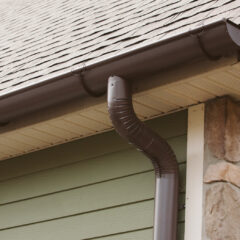






We built our home in 2014. Who is responsible for determining the pitch of roof for gutters? Builder? Gutter company?
It depends on the many factors, but typically the gutter company determines the pitch of the gutters when installed.
Can I get away with four inch. gutters on my 30×60 pole barn?
It really depends on some other factors. Is the barn is 60’ long and the end of roof to it’s peak is 30’ in length? What kind of roof is on the pole barn? Metal or asphalt shingles? Is the area around the barn treed or does it sit in an open field? It’s best to give us a call 856-391-0841 and one of our gutter pros can assist you.
I have one side of a shed that needs guttering that is approximately 12″ and then 2″ around to the back for the down spout. Please give me some recommendations and where to buy. I am in Arlington. TX. I would also prefer it in brown.
Thank you,
MDH
Very impressive .. I really appreciate your work, you explained it very well.
Where is this this?!
“The U.S. Weather Bureau records the maximum rainfall that could possibly happen in a 5-minute period, in inches per hour, for various regions. The higher the amount, the bigger a gutter has to be to keep from being overwhelmed in a storm burst. Download this handy table to find out the number for your area.”
what is the size from the gravel stop to the top edge of the gutter on the outside edge. please info on a so called 5″ and 6″. thank you
Hi there, I have just moved into a
Bungalow and the gutters just keep on overflowing. I have dealt with any blockages or debris and they are all clear. Do you think I need deeper guttering? Thanks
Gutters and installation quote (half round gutters)
Needs gutters installation on renovated house in Rietfontein
Hi Ethel, Please call us at 856-363-3388 for a free estimate. Thank you.
What formula was used in calculating the expansion of aluminum?
I ask because those numbers seem low to me.
Thanks for the info that you’ve provided, it’s a great resource!
Would you be able to recommend a gutter contractor in the north San Diego county area?
Thanks, Mark
What is the largest size downspout available for a 6 inch K gutter?
Can 4 X 5″ downspouts be used with a 6 inch K gutter? I would think the answer would be ‘No’, because the 4 inch depth of a 4 X 5″ downspout would exceed the smaller depth of a 6 inch K gutter.
The 5-min rainfall intensity in Chicago is 0.68in/hr not 6.8in/hr. The effective square footage of the 1,000sqft roof should be 748sqft then, right?
Glad I’m not the only one that caught the order of magnitude error……
If an existing gutter measures 4″ across & approx 3″ deep, how do I know if the gutter is 5″ or 6″?
I only have photos to use.